POINTER CANCELLATION & STROKES
Does Pointer Cancellation Stop a Minecraft Skin Pencil Stroke?
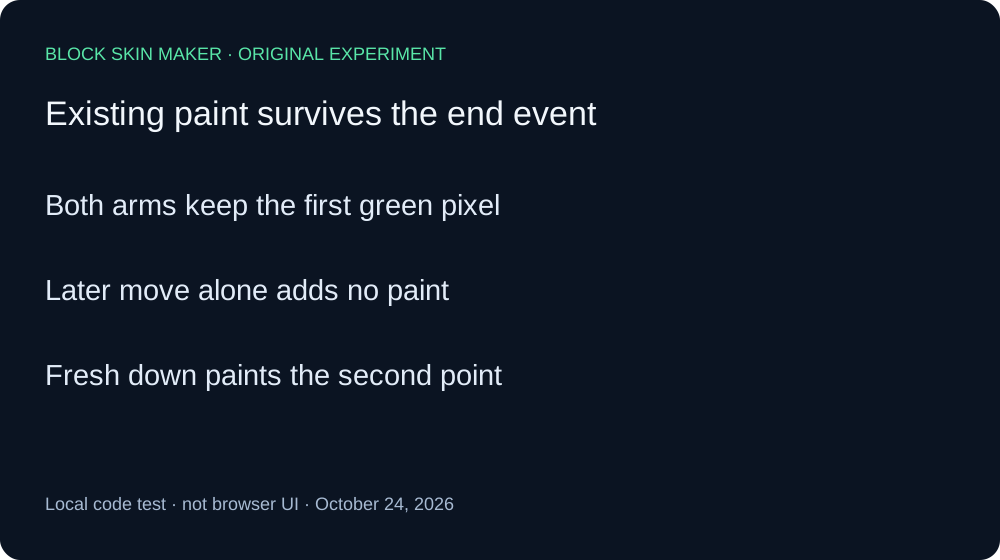
Yes, in this local handler test. After pointercancel, a later pointer-move did not add paint until a fresh pointer-down started another stroke. The pixel already painted remained intact and could be undone. Pointerup produced the same measured result under the same settings.
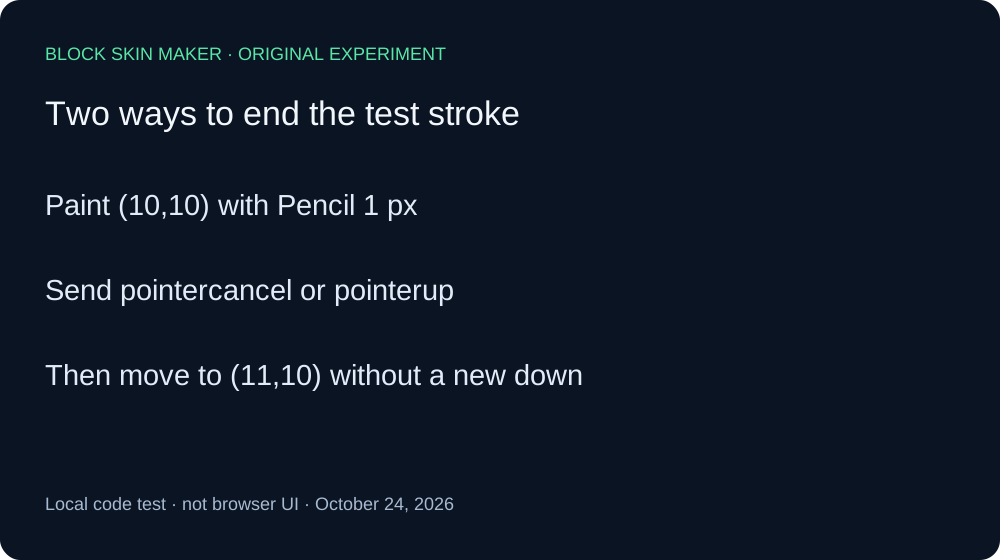
Cancellation and release, compared locally
On October 24, 2026, we executed the unmodified production app.js with its original pointer listeners and a real native Canvas engine. We matched the source bytes against the live script. A minimal DOM adapter delivered the named events directly. This tests how the registered handlers respond; it does not reproduce a browser deciding to cancel a touch gesture.
Both arms began with a transparent 64 by 64 image, Body selected, Pencil size one, full opacity, Mirror off, and green #59E6A8. We sent pointer-down at 10,10, creating one opaque green pixel. Each arm then received a different ending event: pointercancel in the first and pointerup in the second. No other setting changed between arms.
The ending event itself preserved the painted PNG in both cases. We next sent pointer-move at 11,10 without another pointer-down. The new coordinate remained transparent; the PNG stayed byte-identical to the one-pixel image. The earlier point at 10,10 retained RGBA 89,230,168,255. Cancellation therefore stopped further painting in this sequence without deleting the pixel already drawn.
We invoked Undo once after that later move. It returned the canvas to blank in each arm. Redo recovered the original one-pixel file with its exact SHA-256 hash. The ending event and subsequent idle move did not require additional Undo actions before the painted point could be removed. This is a history check for these two sequences, not a general claim about every event route.
After Redo, we sent a fresh pointer-down at 11,10 followed by pointer-up. Both arms now contained two opaque green pixels, at 10,10 and 11,10. This positive control demonstrates that the later coordinate was paintable and a new stroke could start. The unchanged idle-move PNG was not caused by that coordinate being outside the selected layer.
| Stage | Painted pixels | Undo / Redo enabled |
|---|---|---|
| pointercancel-blank | 0 | Off / Off |
| pointercancel-paint | 1 | On / Off |
| pointercancel-ended | 1 | On / Off |
| pointercancel-move | 1 | On / Off |
| pointercancel-undo | 0 | Off / On |
| pointercancel-redo | 1 | On / Off |
| pointercancel-new-stroke | 2 | On / Off |
| pointerup-blank | 0 | Off / Off |
| pointerup-paint | 1 | On / Off |
| pointerup-ended | 1 | On / Off |
| pointerup-move | 1 | On / Off |
| pointerup-undo | 0 | Off / On |
| pointerup-redo | 1 | On / Off |
| pointerup-new-stroke | 2 | On / Off |


Independent Pillow decoding checked all fourteen PNG dimensions, painted coordinates, RGBA values, and SHA-256 hashes against the native Canvas record. The raw ledger preserves the two event names, settings, and control states. The reproduction script includes the fresh-stroke control and complete action order.
We did not measure event timing, pointer capture, a real touch interruption, scrolling, application focus changes, hardware, or browser menus. Receiving pointercancel is different from proving why a device generated it. These files establish the tested handler response only: existing paint survived, the next move alone did not paint, and a fresh down event started another stroke.
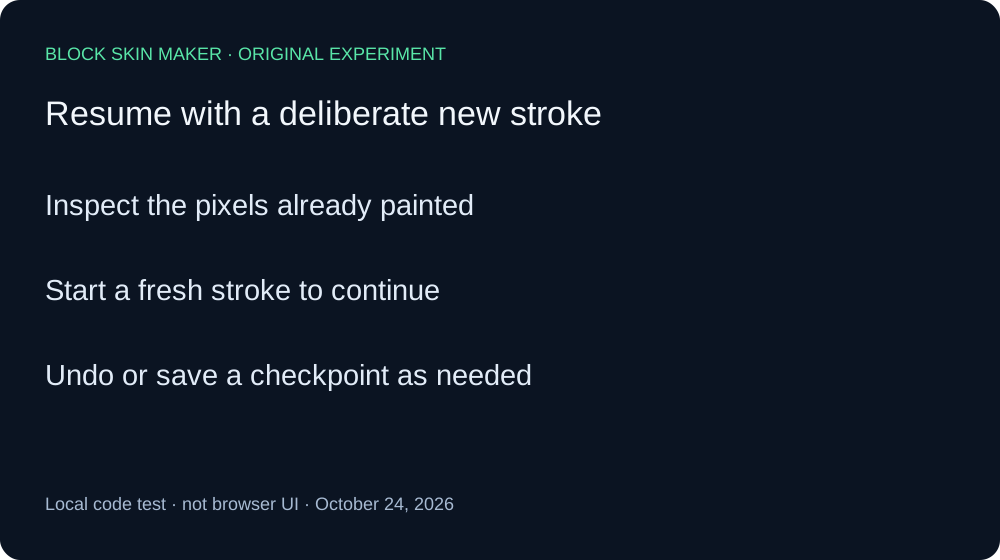
Check the image before resuming
- Inspect what remains on the canvas after an interruption.
- Begin a fresh stroke to continue painting; movement alone did not resume this test.
- Use Undo to remove the earlier edit if needed, and save a checkpoint.
Quick answers
Does cancellation erase the stroke?
It did not erase our existing point. Undo remained a separate action.
Does this diagnose an interruption on my phone?
No. We did not test a phone or determine what generates its cancellation events.
Is the next move automatically a new stroke?
Not here. A fresh down event was needed. See the drag versus click test for another comparison of stroke boundaries.