LARGE BRUSH & LAYER MASKS
What Does a Large Brush Paint at the Body and Overlay Boundary?
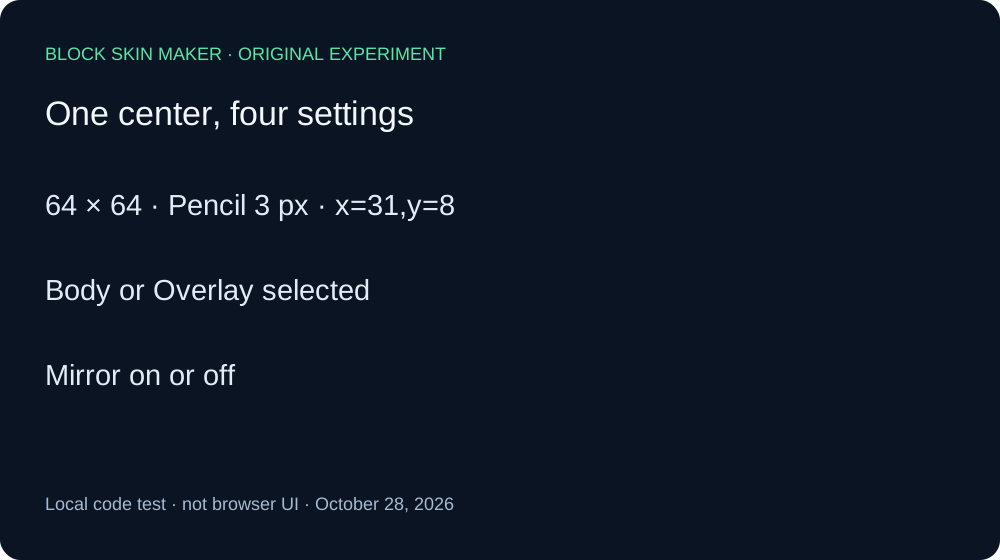
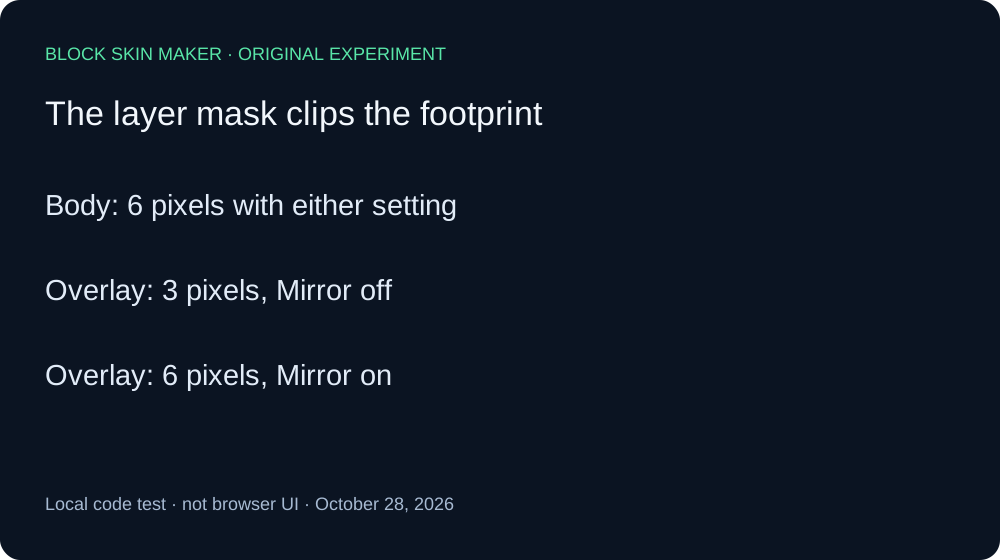
At the head boundary x=31/32, one three-pixel stroke painted six Body pixels, three Overlay pixels, or six Overlay pixels with Mirror on. Body Mirror on stayed at six. The layer mask clipped the brush footprint; the mirrored center only added pixels when its footprint reached valid Overlay columns.
A three-pixel brush at x=31
On October 28, 2026, we executed the unmodified production app.js with its original brush, layer-mask, and mirror handlers. We checked the script against the live file. A minimal DOM adapter connected those handlers to a native Canvas engine, and Pillow independently decoded every PNG. This is a local code experiment, not a browser, phone, or Minecraft test.
Each arm started with a transparent 64 by 64 canvas. We used a three-pixel square Pencil, full opacity, green #59E6A8, and a single pointer-down/up at pixel center 31,8. This column straddles the Body head region ending at x=31 and Overlay head region starting at x=32. The brush therefore extends across that layer boundary. We repeated the same stroke for Body and Overlay with Mirror off and on.
On Body with Mirror off, six pixels were painted: x=30 and 31 across rows 7,8,9. Turning Mirror on produced the same six coordinates. The mirrored center is x=32, but its three-pixel brush falls outside the Body mask at this head edge, so it adds no visible pixels.
On Overlay with Mirror off, three pixels were painted at x=32 across rows 7,8,9. The portion at x=31 was outside the Overlay mask. With Mirror on, the mirrored stroke centered at x=32 also contributed x=33, producing six pixels across x=32 and 33 for those same rows.
These counts come from the mask rectangles and the exact 3 by 3 brush footprint in the original handler. The test verifies those four resulting coordinate sets, not every point on every skin seam. In all four arms, Undo returned to a blank PNG, and Redo restored the painted PNG with an identical hash.
| Layer / Mirror | Painted coordinates | Undo / Redo |
|---|---|---|
| body / Mirror off | [(30, 7), (31, 7), (30, 8), (31, 8), (30, 9), (31, 9)] | On / Off |
| body / Mirror on | [(30, 7), (31, 7), (30, 8), (31, 8), (30, 9), (31, 9)] | On / Off |
| overlay / Mirror off | [(32, 7), (32, 8), (32, 9)] | On / Off |
| overlay / Mirror on | [(32, 7), (33, 7), (32, 8), (33, 8), (32, 9), (33, 9)] | On / Off |
The full pixel ledger lists every coordinate and control state. The reproduction script preserves the four settings combinations. Each PNG was checked for 64 by 64 dimensions, pixel coordinates, RGBA 89,230,168,255, and SHA-256. The production source was not edited to create the result.
Only brush size three at the head boundary, one center coordinate, and two layers were measured. Larger brush sizes, other body regions, skin model rendering, real mobile layout, and game behavior were not tested. Treat this as a precise edge example, not a count for every large brush stroke.
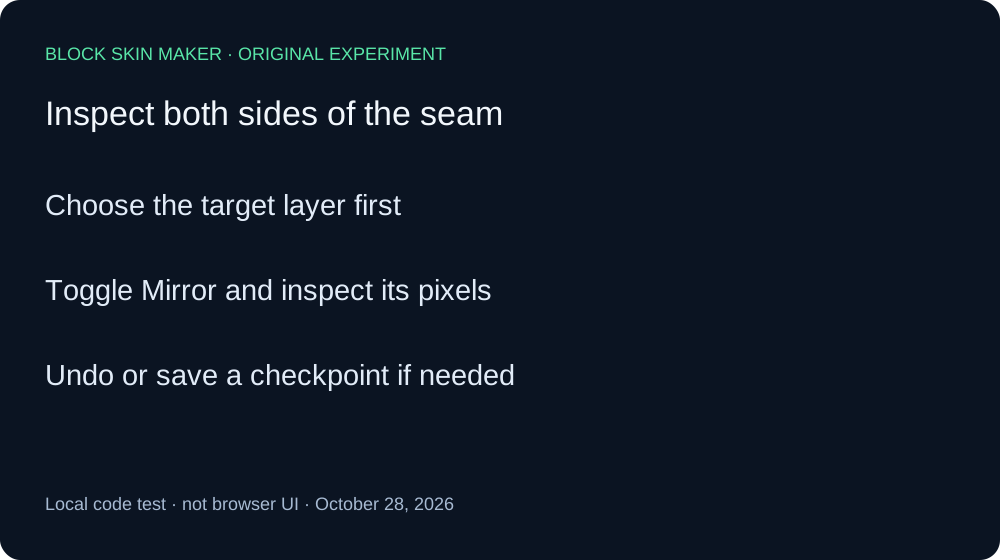
Check both layers near a seam
- Select the intended layer before making a wide stroke.
- Zoom in on pixels along both sides of the boundary.
- Toggle Mirror and inspect the opposite side before continuing.
Quick answers
Does a three-pixel brush always paint nine pixels?
No. At this mask boundary, the layer clipped some of the 3 by 3 footprint.
Did Mirror always double the painted area?
No. It added no pixels in the Body arm, but extended the Overlay arm from three to six.
Can I apply these counts to the legs or torso?
Those coordinates were not tested. Use the layer guide to understand the two surfaces, then inspect your own stroke.